



Summary
After completing the lesson, students will be able to:
- Ask and answer questions
- Participate in dialogues and conversations on familiar topics
- Read and understand written instructions
- Understand texts
Task A: Choose a health problem from the provided list and match it with the suitable pictures. The following problems are given:
- a fever
- a backache
- a cough
- a headache
- a toothache
- a skin injury
- a stomachache
- a cold
- a burn
Task A1: Work in pairs to discuss recent health problems and remedies.
Task B: Review the health problems and choose suitable advice for each. Examples include:
- For a cough: gurgle with warm water, take vitamin C
- For a backache: put a heating pad on it
- For a fever: take paracetamol
- For a toothache: see a dentist
- For a headache: rest or see a doctor
Work in groups to provide advice based on section B, encouraging multiple suggestions per issue.
Task D: Engage in brief conversations about various health problems and remedies.
Health Overview: A proverb states that "Health is Wealth." Good health means functioning well physically and mentally, leading to an active and happy life. Key health practices include:
- Balanced diet: Proportions of carbohydrates, fats, protein, vitamins, and minerals
- Personal hygiene: Hand washing, regular bathing, clean clothing, dental hygiene
- Household cleanliness: Maintaining a clean environment
- Nutritious food and pure water: Consuming fresh and properly cooked food
- Regular exercise: Engaging in physical activities
- Adequate rest: Ensuring enough sleep and relaxation
Respond to comprehension questions regarding hygiene, the essentials of good health, the balanced diet concept, and personal hygiene rules.
Task F: Listen to a conversation, fill in the blanks with appropriate words, and practice saying the dialogue in pairs.
Task F2: Summarize Simon’s exercise regimen and write about one’s own fitness routine.
Task G: Compose a paragraph outlining the rules for maintaining good health based on previous discussions.
After completing the lesson students will be able to
- ask and answer questions
- participate in dialogues and conversations on familiar topics
- read and understand written instructions
- read and understand texts
A . Choose a health problem from the box and write next to the appropriate picture. There are names of more problems in the box than are necessary.
| a fever, a backache, a cough, a headache, a toothache, a skin injury, a stomachache, a cold, a burn |
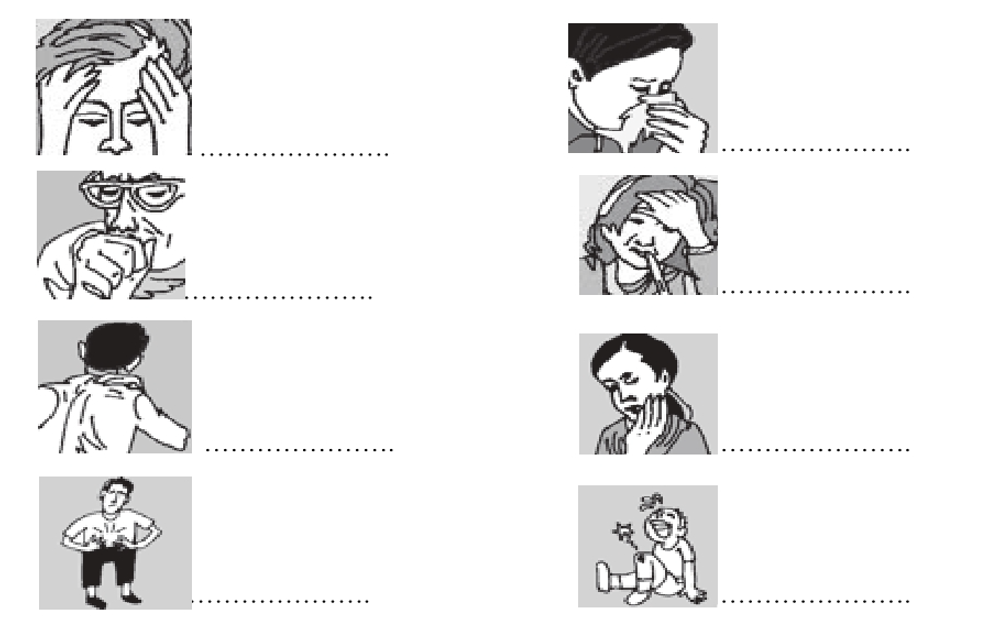
A1 Work in pairs. Ask and answer the following questions.
- Have you had any of these or any other health problems recently? Which ones? or what?
- How many times had you been sick in the year?
- What do you do when you have a headache or a cold or a toothache?
B . Look at some health problems. Choose several pieces of good advice for each problem. There are more pieces of advice than problems.
Problems
- a cough. _______
- a backache. _______
- a fever. _______
- a toothache. _______
- a headache ______
- a burn. ________
- the flu ________
Advice
a. take some vitamin C
b. put some ointment on it
c. drink lots of liquid
d. take enough rest
e. put a heating pad on it
f. put it under cold water
g. take some paracetamol
h. gurgle with warm and salt water
i. see a dentist
j. see a doctor
Work in groups. Talk about the problems in section B and give advice. Try to give more than one piece of advice for each problem. Follow the model shown.
(A) What should you do for a cough?
(B) You should gurgle with warm water.
(C) It's a good idea to take some vitamin C.
(D) Yes. And if it continues for long, you should see a doctor.
(E) Well, I think it's good to avoid cold drink or ice-cream.
(F) Sometimes it helps to ________
(D) Work with a partner. Make a short conversation about each problem and its remedy in the box below.
Problem Remedy |
(A) Have you ever had an insect bite?
(B) Oh, yes! I had one just last night, actually.
(A) What did you do?
(B) I put some antiseptic on it.
E Read the text.
A proverb says 'Health is Wealth'. To keep healthy is to keep free from disease and anxiety. Good health is proper functioning of all body organs. It is also feeling well both in body and in mind. People in good health are active, cheerful and happy. If you are healthy, you can be happy and can help others in society as well.
To keep in good health we should be careful about hygiene. The rules and practices of keeping good health are called hygiene. We must practise the rules of hygiene. Proper food and nutrition, physical exercise, rest and sleep, cleanliness, and proper medicare are essential for good health.
Some important rules of good personal health are as follows.
a. Balanced diet: Our food should contain correct proportion of carbohydrates, fat, protein, vitamins, minerals and water in it.
b. Personal hygiene: We should follow the personal health practices, such as,
- Wash your hands before eating
- Bathe regularly and wear clean clothes
- Brush your teeth twice regularly
- Do not let your nails grow long. Cut them regularly
- Wash your feet and hands before going to bed.
c. Cleaning household: We should keep our household and environment clean
d. Taking clean food and water: Our food should be fresh, clean and properly cooked, and water should be pure.
e. Taking regular exercise: We should take part in games and sports and take physical exercise regularly.
f. Taking regular sleep and rest: We should sleep properly and take proper rest.
E1 . Answer the following questions.
1 What do we mean by hygiene?
2 What are essential for good health?
3 What do we mean by balanced diet?
4 What are the rules of personal hygiene?
F . Listen to the conversation and fill in the blanks with suitable words.
Sohan Hi, Simon! You look so fit! Do you exercise regularly?
Simon Yes, I do. I'm quite ____ about fitness.
Sohan So, how ____ do you exercise?
Simon Well, I do jogging everyday in the _______ Then I play table tennis in the afternoon.
Sohan I like table tennis, too.
Simon Oh, will you come to play ______ then?
Sohan Sure. But ________ do you play?
Simon Pretty well, I guess.
Sohan All right. But I'm not very good
Simon No problem, Sohan. I won't play ______
F1 . Listen to the conversation again and then practise saying it in pairs.
F2 . Read what Simon says about his physical exercise programme.
| I'm Simon. I love to exercise. I usually exercise every day. I get up early in the morning and do jogging for half an hour. Almost regularly, I play table tennis in the afternoon. Sometimes, I play football. Once a week, I do yoga. |
F3 . Now, write about what you usually do or would like to do to keep yourself fit.
G . Write a short paragraph on the rules of good health. Take your cues from E.

Read more